Summer Terrace Ideas: Designing an Outdoor Space
Your Terrace Is Not a Waiting Room
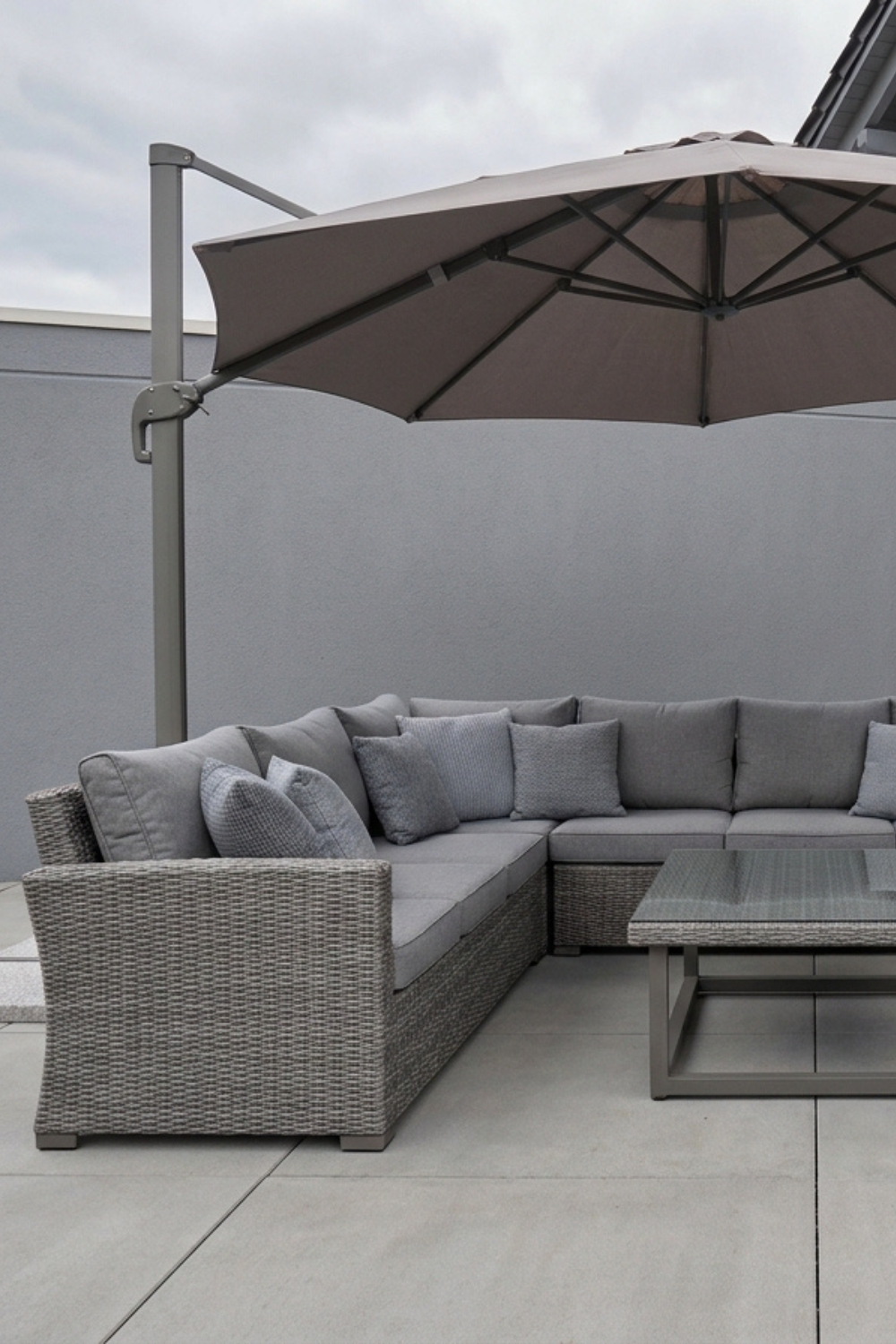
Every summer it appears again. I walk through my neighborhood, or past the long rows of balconies on the way into town, and there it is on terrace after terrace: the gray set. The same molded faux-rattan sofa, the same low table with its sheet of smoked glass, the same flat cushions the color of wet concrete. Different sizes, different railings, the same quiet resignation. Here in Germany it has become something close to a default. A terrace is built, a summer arrives, and the gray set moves in like it was always meant to be there.
I find it genuinely sad. Not because it's cheap, because it usually isn't. You can buy a warmer, stranger, more alive sofa for nearly the same money. It's that the gray set looks cheap while costing real money, and worse, it looks like nobody made a single decision. It is the color of indecision rendered in plastic. Soul-sucking is a strong word and I'll use it anyway, because that's what it does to a space. It drains it.
Summer asks something of us. It asks us to slow down, to eat outside, to let an evening run long. The gray set is a way of not answering.
The most neglected room in the house
Here is something I notice in almost every home, including my own for years: we will agonize over a single armchair for the living room. We'll test the fabric, sit in it at the showroom, send a friend a photo, wait for the right one. And then we'll furnish the entire terrace, the one place where we'll actually watch the sun go down all summer, with whatever came as a set.
The terrace is a room. It just happens to have sky for a ceiling. It deserves the same attention we give the rooms with walls, and arguably more, because it's the only one that changes with the light and the season and gives most of that back to us in the months when we need it.
When I finally started treating my own outdoor space as a real room rather than a leftover, something shifted in how I used the whole house. The door stayed open. Coffee migrated outside. The terrace stopped being a place I looked at through glass and became a place I lived in.
You can't furnish what you haven't defined
This is the part most people skip, and it's the reason the gray set wins by default. They start with the furniture. They walk into the garden center, see a set that fits the budget, and buy the answer before they've asked the question.
The question is simple: what is this space actually for?
Not in the abstract. For you, in your life, in the way you actually spend a week. A terrace that's perfect for long dinners with eight people is wrong for the person who really just wants to drink her coffee there in the quiet before anyone else is awake. The furniture, the layout, even the colors all follow from that one honest answer. Get it right and the rest becomes obvious. Skip it and you end up with the gray set, because the gray set is the thing you buy when you haven't decided anything.
So before you choose a single cushion, choose a purpose.
A mini guide: what is this space actually for?
Here are the modes I see most often. Most spaces lean toward one, borrow a little from another, and that's the whole game. Read them as a feeling first, then ask yourself the question underneath, then notice the direction it points you.
The Morning Ritual
The feeling: first light, a warm cup, no one talking yet. This is the terrace as a private start to the day rather than a stage for company.
Ask yourself: where does the sun actually land at seven in the morning, and is that where I'd want to sit?
If this is your space, you need less than you think. A single good chair or a small two-seater, a surface big enough for a cup and a book, placed exactly where the early light falls. The palette wants to be soft and warm: cream, oatmeal, the pale wood tones that glow rather than glare when the sun is low. Nothing that competes with a quiet morning.
The Decompression Oasis
The feeling: the exhale at the end of the day. Reading until the light goes, watching the sky change color, doing nothing on purpose.
Ask yourself: when I imagine the version of this terrace that actually relaxes me, am I sitting up or am I sinking in?
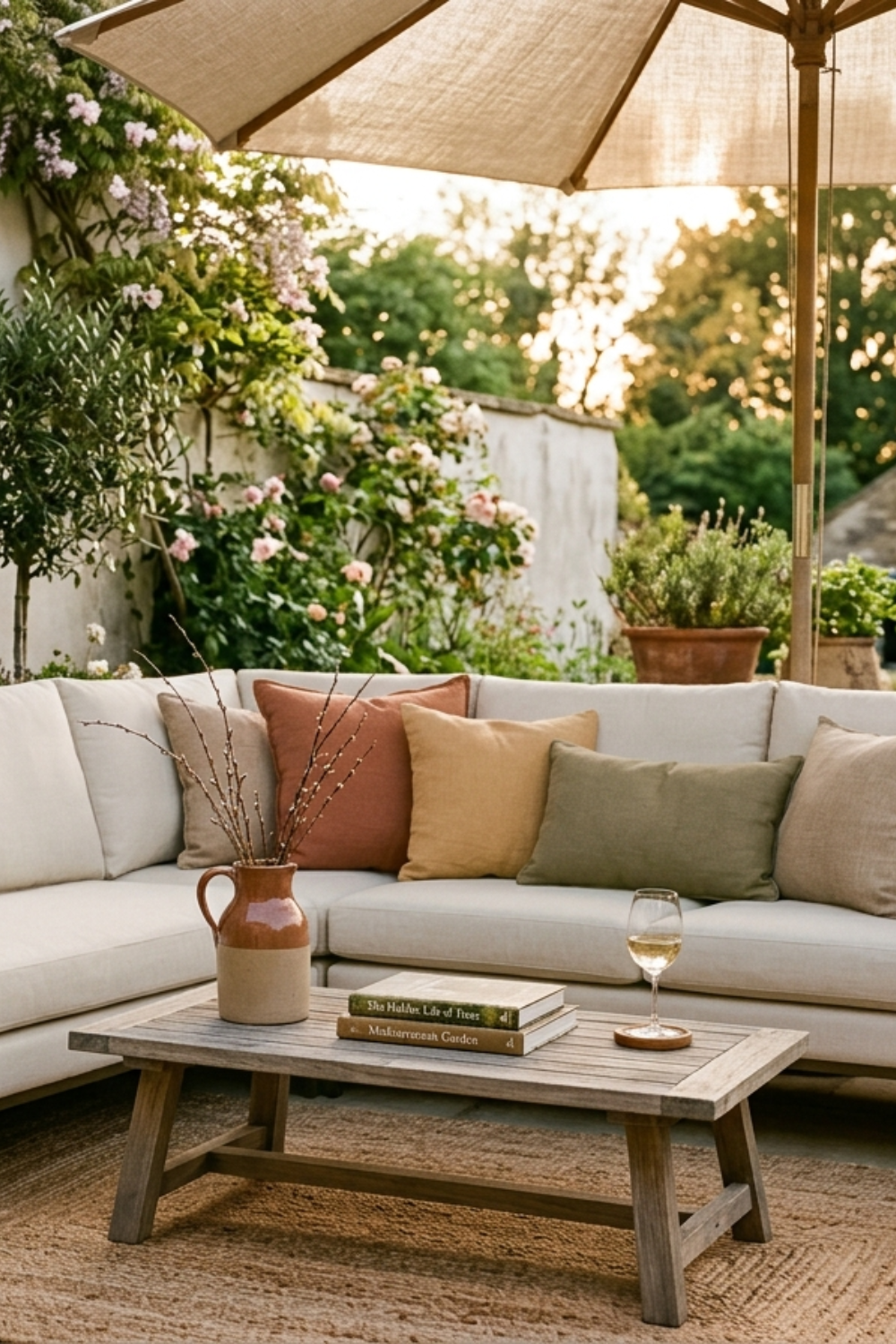
This is the one space where deep, soft, lounge-style seating earns its keep. A proper armchair you can fold into, a lounger, something with a footrest. Layer it with texture, because tactility is what tells your body to let go. The palette can go deeper and moodier here: muted greens, soft terracotta, faded indigo, the colors of dusk rather than midday.
The Gathering Table
The feeling: long dinners, refilled glasses, the meal that turns into three hours because no one wants to leave the table.
Ask yourself: how many people do I really host, honestly, more than once a summer?
If hosting is your purpose, the table is the hero and everything else serves it. Invest there: a generous, well-made table and chairs people can sit in comfortably for hours, not the kind that has them shifting after twenty minutes. Keep the lounge seating minimal so the space doesn't fight itself. The palette can carry more confidence, because a gathering space should feel alive: a saturated accent against warm neutrals, something that reads as celebration rather than caution.
The Family Floor
The feeling: open, forgiving, a bit loud. Kids in and out, a dog underfoot, sticky hands and spilled juice and none of it a tragedy.
Ask yourself: what do I want to never have to worry about out here?
Durability is the whole brief, but durable doesn't mean ugly and it certainly doesn't mean gray. Choose materials that wipe clean and age honestly, fabrics that forgive. Keep the floor as open as you can. The palette can take some real color here, because color hides life better than pale ever will, and a family space should look like it's allowed to be used.
The Honest Hybrid
The truth is most real terraces are some of all of this. Morning coffee on weekdays, a long dinner now and then, the kids out there constantly. The mistake isn't wanting more than one thing. It's pretending you want them all equally and designing for none of them.
Ask yourself: if I'm honest about my week, which one of these happens almost every day, and which one happens a handful of times a year?
Rank them. Design fully for the thing you do daily, accommodate the occasional thing with something flexible, and let the rare thing be rare. A terrace built for your real life beats one built for the life in the catalogue every single time.
Where to go from here
Once you know what your space is for, every other decision gets lighter. The furniture nearly chooses itself. The palette stops being a guess. The gray set, which only ever made sense as a way of deciding nothing, falls away on its own.
In the post that follows, I'll go deeper into five of my favorite color combos for a terrace styling.
Disclaimer: AI-assisted writing and mock-ups applied.