Materiality as a Connecting Thread in Home Styling
How repeating textures and materials create quiet connections between pieces that have no other obvious relationship.
Color works across a room as a whole. Materials work more locally, creating relationships between specific pieces rather than unifying everything at once. The two tools are different in scale and effect, and the most resolved rooms use both.
When I talk about materiality as a connecting thread, I mean the deliberate repetition of a specific material or texture in two or three places across a room, so that the eye registers a relationship between those pieces even when their form or style is entirely different. It is subtle and it works precisely because it is subtle. You often do not consciously notice it, but you feel the room as more cohesive than it would otherwise be.
How Repetition Creates Cohesion
The example I come back to most often is brass. Not brass as a dominant material, but brass appearing in small amounts in specific places: the handle on a cabinet, the base of a lamp, the frame of a small mirror, the edge of a picture frame. None of these objects have the same form or function. But the material links them the way a color undertone links a palette, and the room reads as assembled with intention rather than accumulated without it.
The same principle applies to wood tones. If you have three different wood pieces in a room, each from a different era or tradition, the question is whether their tones are close enough to feel related. A room with dark walnut, pale ash, and orange-toned pine will feel unsettled. A room where every wood tone sits in the same warm-to-amber range will feel coherent, even if the forms of the furniture are entirely different.
Two pieces do not need to match. They need to have something to say to each other.
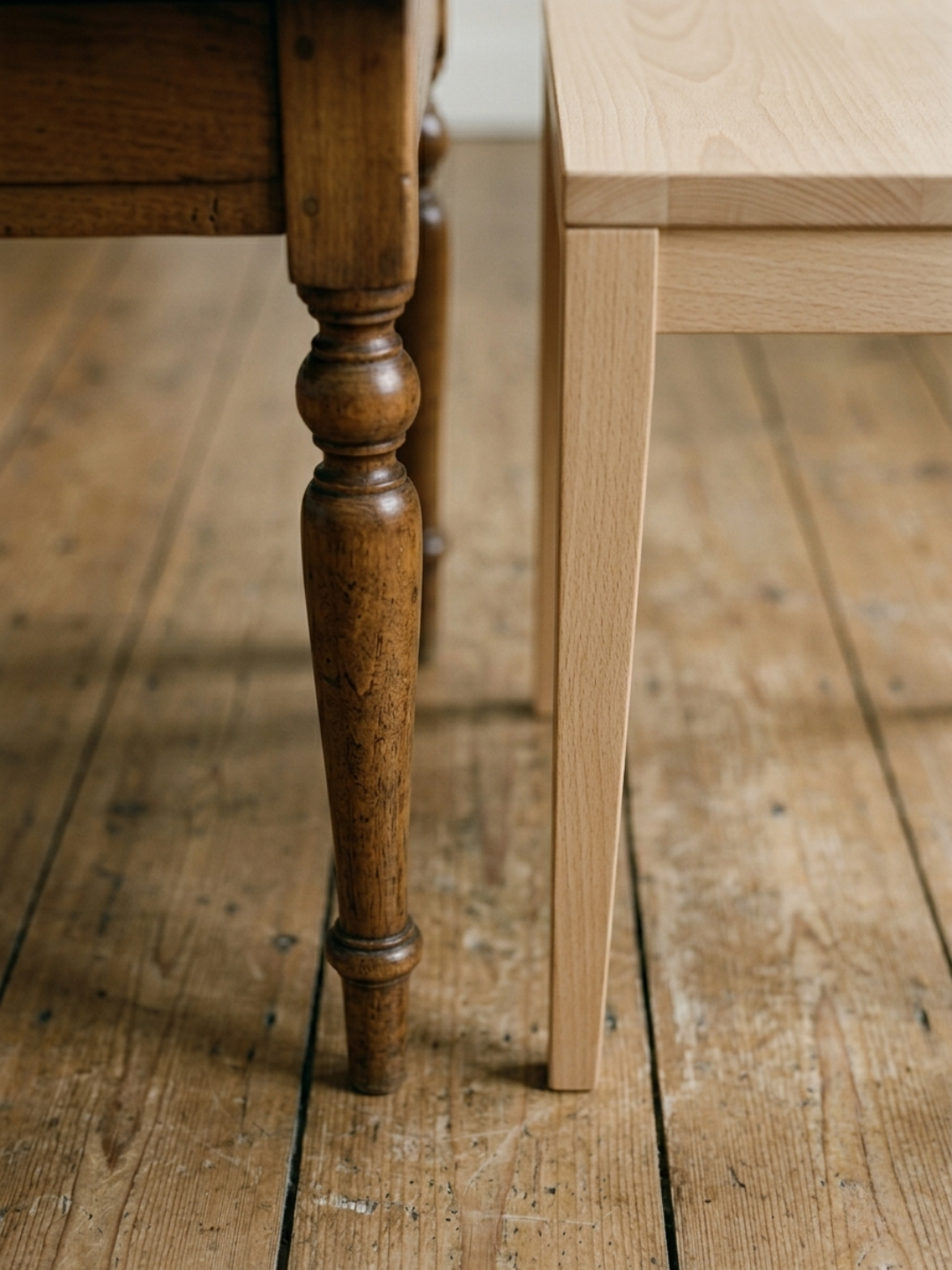
The Materials Worth Repeating
I tend to work with two or three materials across a room rather than one, which gives enough variety to avoid monotony while maintaining the connections. In my current home, those materials are aged oak, matte black iron, and raw linen. Each appears in different forms and at different scales, but they recur consistently enough that the room has a material logic to it.
Aged oak appears in the dining table, the top of a low sideboard, and the frame of a small artwork. Matte black iron appears in the pendant light, the handles of the kitchen cabinetry, and a thin-framed floor lamp. Raw linen appears in the main sofa upholstery, a pair of cushions, and the shade of a bedside lamp. Three materials, repeated in different contexts, creating connections across the room that hold the different pieces together without any of them needing to match.
Avoiding the Matching Trap
The opposite of this approach is what happens in many well-intentioned rooms: matching material sets purchased together, where the coffee table, side table, and console are all the same wood, the same finish, and the same provenance. This creates a different kind of coherence, but a less interesting one. Everything belongs to the same family because it literally is the same family. There is no discovery in it.
Deliberately repeating a material across pieces that are otherwise different creates a more earned coherence. The connection is there, but you have to look for it. That quality of quiet, discoverable logic is what makes a room feel designed rather than furnished.
The practical implication is that when I am considering a new piece, one of the questions I ask is: does this share a material with something else already in the room? If it does, and if that material is one I want to reinforce, that is a reason in its favor. If it introduces a fourth or fifth material that has no relationship to what is already there, that is worth pausing on.
Disclaimer: AI-assisted writing applied.