The 80/20 Rule for Aesthetic Balance in Home Design
How I think about establishing a dominant style while leaving room for the things that do not quite fit.
A room that has been curated to within an inch of its life tends to feel like it is performing rather than living. Everything matches, everything is considered, everything belongs to the same aesthetic family, and the result, however beautiful in photographs, can feel slightly airless in person. There is no tension, no surprise, nothing that makes you stop and look twice.
The rooms I find most interesting have a clear dominant register and then, somewhere, something that does not entirely obey it. A lamp that is a little rougher than everything else. A chair that is darker, or older, or from a different tradition. These anomalies are not mistakes. They are the things that make the room feel like it belongs to someone.
What the 80 Percent Does
The dominant eighty percent of a room creates the conditions in which the twenty percent can be interesting rather than disruptive. Without a clear aesthetic foundation, an unusual piece just reads as out of place. With a strong enough foundation, that same piece becomes a point of focus.
In practical terms, the eighty percent is usually the walls, the floor, the largest pieces of furniture, and the dominant palette. These set the register of the room. Once they are decided, there is a lot of clarity about what kinds of departures will add to the room and what kinds will simply undermine it.
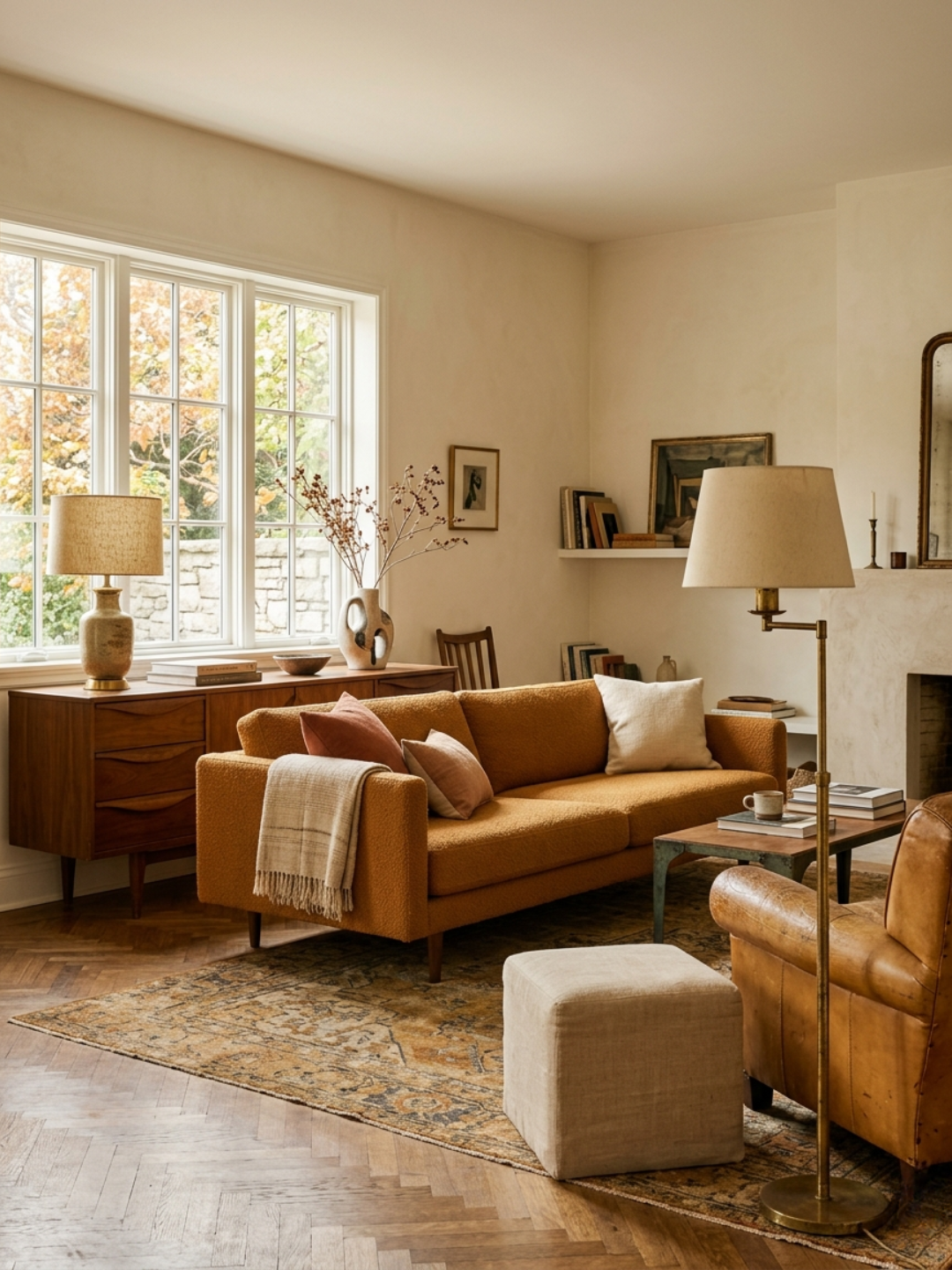
My own living space leans toward the quiet and the restrained. Pale walls, clean lines, a limited palette of warm neutrals and muted greens. That is the eighty percent. It creates a certain atmosphere, calm and somewhat spare, that I want as the baseline experience of the room.
The dominant eighty percent creates the conditions in which everything else becomes interesting.
What the 20 Percent Does
The twenty percent is where the room acquires character. In my case it is a handful of things that do not belong to the quiet, contemporary register of everything else. A large ceramic vessel with an uneven glaze and a slightly raw quality that the rest of the room does not have. An inherited wooden chair with carved details that would read as fussy in a room full of similar things, but reads as singular in this one. A textile with a pattern that is more saturated and more graphic than my usual palette.
None of these things match the dominant aesthetic. All of them belong in the room. The distinction between those two statements is what the eighty/twenty principle is actually about. Matching and belonging are different things. A piece belongs when it contributes something the room needs, even if it does not match what the room already has.
How to Apply It Without Overthinking It
The useful version of this principle is not a calculation. You do not actually measure whether your room is eighty percent one thing and twenty percent another. It is more of a test you apply when you are considering bringing something new in.
The question I ask is: does this reinforce the dominant register of the room, or does it depart from it? If it reinforces it, I think about whether the room needs more of that quality or whether it already has enough. If it departs from it, I think about whether the room has the capacity to absorb that departure, whether there is enough foundation in place that an anomaly will read as intentional.
A room with a very tentative aesthetic identity tends to be disrupted by departures. A room with a confident one tends to benefit from them. The eighty percent is not just about aesthetics. It is about creating enough certainty that uncertainty, when you introduce it, looks like a choice.
Disclaimer: AI-assisted writing applied.